We know what's keeping you up at night.
Before we show you the solution, let's name the chaos — because you shouldn't have to pretend it isn't there.
Twelve folders deep. Zero results.
Your special collections staff knows the 1940s labor photography archive exists — somewhere. New researchers give up after three emails. Institutional memory walks out the door every time a staff member retires.
One Mac Pro stands between you and 40 years of history.
Your photo archive lives on a 2009 Mac Pro running Snow Leopard. The hard drive makes a new sound every six months. You have a restoration grant proposal due in three weeks and no way to share previews with the committee.
Decades of voices. No way to find them.
You have 800 oral history recordings on DAT tapes, MiniDisc, and MP3s in three different folders. No transcripts. No metadata. No way for a researcher to discover that the 1987 interview with Congressman Harris even exists.
Now watch what happens when collections are finally set free.
Every problem above has a mirror. Here's what the same institution looks like after Stacks.
The same collection. Completely transformed.
Stacks doesn't just move files. It gives your collection a second life.
Type three words. Find the exact photograph.
Full-text OCR, AI-assisted tagging, and faceted search turn your 12-folder-deep archive into a live catalog. Researchers find what they need in seconds. Your staff spends time on scholarship, not archaeology.
Your collection lives in the cloud. Accessible everywhere.
We migrate your materials from aging hardware to a redundant, geo-replicated archive with automatic backups. Your 1920s glass plate negatives are as safe as they've ever been — and shareable with a single link.
Every voice, transcribed and discoverable in days.
AI transcription converts your DAT tapes and MP3s into searchable, timestamped text. Researchers can search across 800 interviews in seconds. The 1987 Harris interview surfaces when anyone searches "labor rights" or "district 12."
The Whitfield Archive
40,000 unsorted negatives. 90 days. A living public collection.
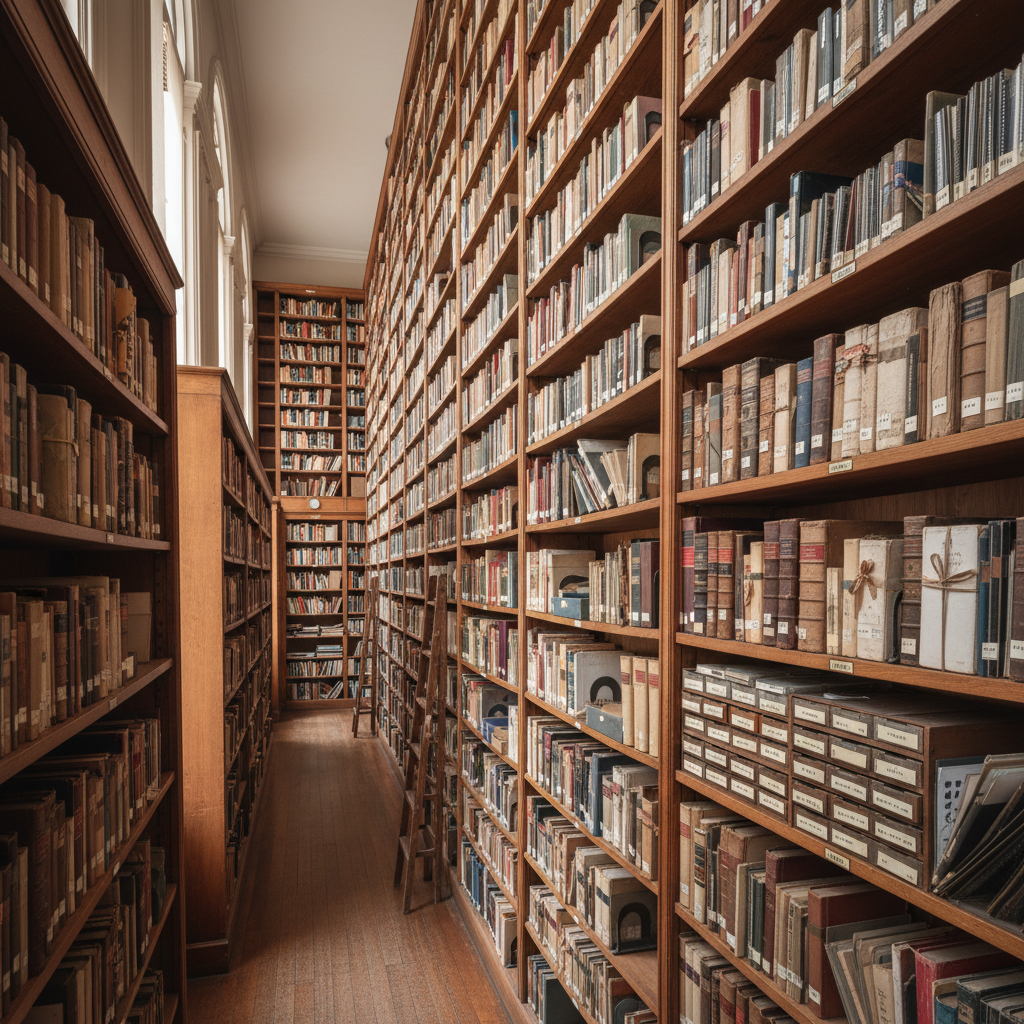
Whitfield Regional Museum
Burlington, Vermont · Photography Collection 1908–1979
Results After 90 Days
"I've been a curator for 22 years. I didn't think we'd live to see this collection actually findable. Stacks did it in a quarter."
Margaret Holloway
Chief Curator, Whitfield Regional Museum
Get the Full Case Study
See exactly how the Whitfield Archive went from 40,000 unsorted negatives to a public digital collection in 90 days — including the full migration process, costs, and timeline.
No phone number. No last name. Just email.
Start Your Collection Audit
Tell us about your collection. We'll come back with a clear picture of what it would take to make it findable — no obligation, no sales pitch, no phone number required.
Collection Assessment
We map what you have, what format it's in, and what's at risk.
Migration Roadmap
A clear timeline and cost estimate tailored to your institution.
Grant Alignment
We flag digitization grants you're eligible for right now.